Showing posts with label boardgame. Show all posts

Saturday, June 14, 2014

Go: A Game of Stones

Just FYI, my blog hit 500 page views this week.  That's a nice round number, half a millennium.

So in honor of this first milestone, I wish to tell you about my favorite game ever:

Go.  That's the name of the game.  I don't want you to go anywhere.  I want you to stay here and keep reading.
 
It is an abstract strategy game at it's finest.  Few rules, endless variability, and looks great on a coffee table.

I've been playing Go for almost 8 years now, long before I got really into designer boardgames as a hobby.  It is the only game I have rated a solid 10/10 on my boardgamegeek profile.  Every other great game can only get at best a 9.5, because that is a rule I set for myself.  Go is my favorite and that will never change.  It is so great, I made sure it was the inaugural game on my game table.

But enough about me.  You come here to hear about the games.  Or maybe you come here for me.  That would be quite flattering.

Go requires only a few components: A board and some stones.

The board consists of a 19x19 grid of lines.  That's it.

Here's mine:

My precious.
My board is made of bamboo, 3/4" thick.  It's a pretty good looking board for pretty cheap.  And it's a favorite of pandas.
Boards come in a variety of woods and thicknesses.  Thicker boards and nicer woods cost more.  The one I have is a table board, but you can get ones with feet on them that are meant for placing on the floor.  The fanciest boards are floor boards made from 700 year old Kaya trees grown in a particular region of Japan and are like 8 inches thick or something.  They can run several hundred thousand dollars. *Sigh*...I can dream.

You also needs stones.  Here are my Go stones (not to be confused with my gall stones).

A bowl of stones.
These are the black stones.  There are also white ones.  They come in fancy wooden bowls.  Everything about this game screams fine craftsmanship.
These stones are made out of Yunzi.  Few know what they are actually made of; it's a secret Chinese recipe.  Yunzi stones are relatively inexpensive but still look and feel very nice.  And the black ones are known for the strange green glow when held up to the light.
Probably the most well known/ fancy stones are shell and slate (the white ones are from shells, and the black from slate).  The shells are from polished shells of a particular Japanese clam, and they have just lovely lovely patterns on them.  They are also expensive. *Sigh*...I can dream.

The game starts with 2 players, each with a set of stones, and an empty board.

My blank canvas.
Starting with black, the players take turns placing stones of the intersections of lines of the board.  The goal of the game is to secure territory by enclosing areas with your stones.  This is complicated by the fact that there are capturing rules that "kill" stones if they get surrounded by an opponent's stones in certain ways.  Those rules are hard to explain quickly.  I'll refer you to the Wikipedia page for that.

But when you capture an opponent's stone, you get to clink it into the lid of your stone bowl for safe keeping.
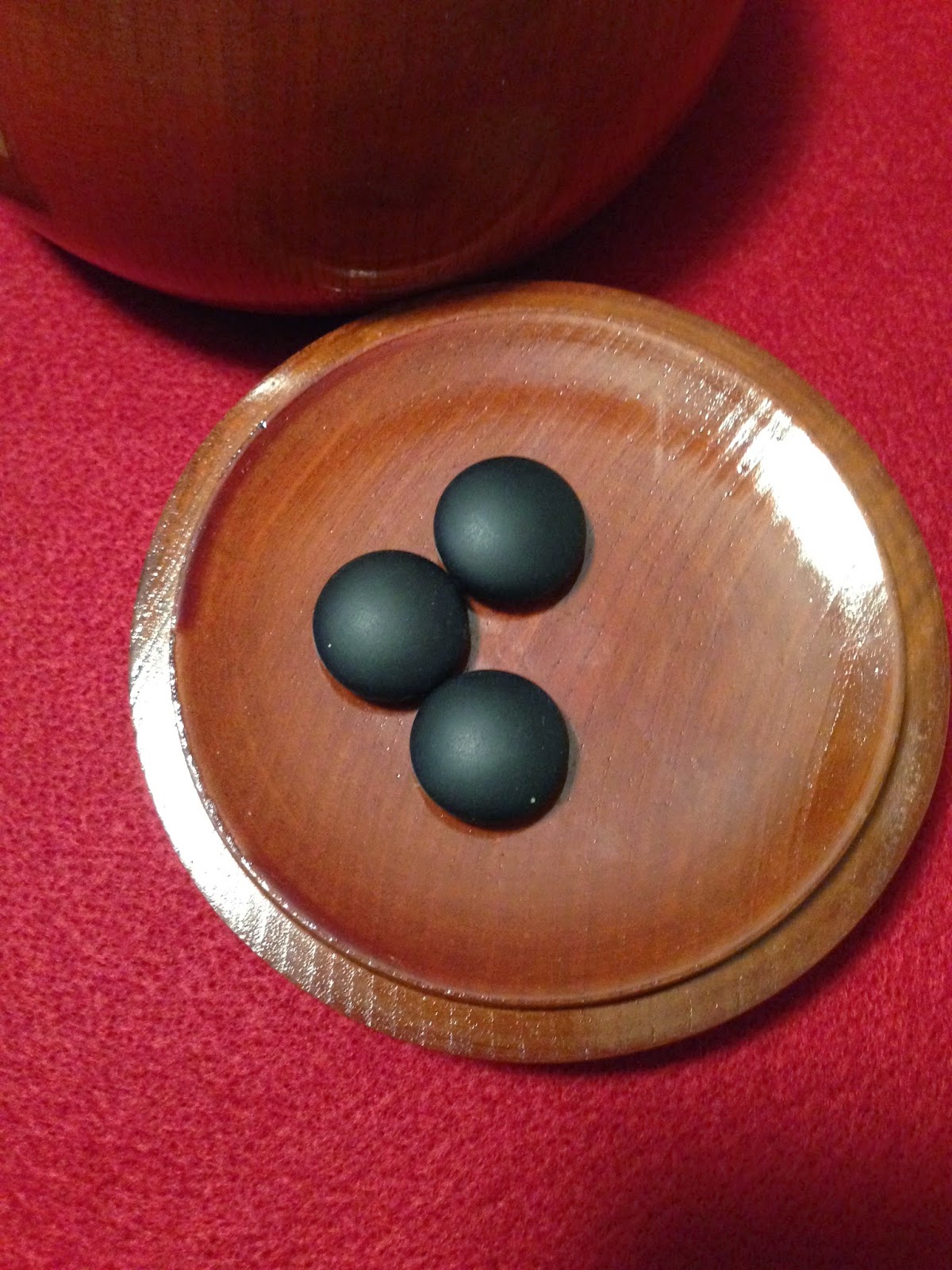
My captures
 These are my skinny fingers placing a stone on the board.  That weird grip is the proper way to hold a stone.  To place the stone, your index finger slides out and your middle finger presses the stone onto the board with a satisfying 'clack,' or 'thwak' if you really get into it.  I save my 'thwak' for moves that say "sorry, but you probably just lost."


Throughout the game, you make all sorts of pretty shapes.  Some of them are common enough to have names.  Like this one:

Bamboo joints!!
This shape is called bamboo joints!!  Yay panda!! 
Ahem...excuse me.

Once both players decide there is nothing useful left to do and pass, the game ends.  You then count the spaces that you have enclosed by your stones plus the number of stones you have captured to get a final score.  Since black went first in the game, a slight advantage, white is award an extra few points to compensate called komi.  There are several different sets of scoring rules, but I usually play by Japanese scoring rules which award a 6.5 point komi to white.  The 0.5 point ensures that there are no ties.  Good games can be won by only that half a point. 
This is how a game with my brother turned out.  I played white, he played black.  It was not a good game for me.

This is a disaster for white.
He won by an embarrassingly large margin.  Maybe you can see it, but black owns a lot more spaces than white.  It's disgusting.

Anyway, I like Go a lot.  It has simple rules, but is actually a very complicated, deep game.  If you want to learn a lot, I would suggest checking out Sensei's Library.  It has everything from beginner's tips to advanced strategies and position analysis.  It's great. 

You can also find several Go servers that let you play with people online.  KGS is nice for live games, and is especially accepting of beginning players.  Dragon Go Server (DGS) is my favorite, and is a faster modern equivalent of playing by mail.  That is, you have a time limit of like 30 days or something and the players don't have to be online at the same time, it's all done turn by turn at your leisure.  I like this style actually.  And I also like dragons.

So I would of course recommend that you try Go.  All the cool people are playing it.


I'm allowed to reuse this panda picture from a previous post because it is way too adorable to use only once.

Saturday, April 19, 2014

Tzolk'in The Mayan Calendar: The Spinning Wheels of Doom

Tzolk'in the Mayan Calendar is a game about Mayans, and their workers who eat corn, and offering skulls to the gods so that they give you points, and spinning wheels.

Not "spinning wheel" like Sleeping Beauty being clumsy around a thread making machine.  "Spinning wheel" as in plastic gears that spin on the gameboard, moving all your dudes around and around with each turn to different spaces on the board.  More on that later...

I'm not sure how to pronounce the game title, exactly.  But the way I pronounce it (which is, then, the correct way) is "Zol-kin."  Kind of like "Zoltar," the magic fortune-telling machine from the Tom Hanks classic "Big."  (You know you've seen it.  Giant piano scene?  Yeah, you love that.)
I made the "T" silent.  I bet it is.  It should be.  More "T"s should be silent.

...Here's the box:

Halloween costume idea.

Yeah, he's holding a skull.  A crystal skull.  It's very important to the game.

"To game or not to game?  That is the question."
You know what? While we're at it, let's throw in the expansion to this game: Tribes and Prophecies.  You see, this is one of my favorite games.  And it's like buying a Barbie where you can't just have the doll but also have to accessorize and buy the dream home and the pink convertible and a Ken when she gets lonely and....wait what was I talking about?
Oh, yeah, I like the game and so I bought the expansion to add even more mechanics to the game and hopefully make it better.

Here's the box for the expansion, too.  Because you LOVE pictures of boxes.

Moe, Larry, and Curly.

Check out the game board, pre-game.  There's a lot going on already.  And you get a sneak peak at the spinny wheels.


The basic idea of the game is that on a turn you either place workers on the game board or pull them off (only one or the other, no a combination of both).  Placing workers gets them on the board spaces, and pulling them off allows you to take the action corresponding to the space they are on.  But...
Each turn the wheels spin, pushing your workers to a new space.  Typically, the longer you let your guys ride on their Mayan Merry-Go-Round the better the actions become.  So you want to find a balance between doing stuff and having patience to let your guys chill so they can do better stuff later.

One of the spinny wheels, connected to the bigger central spinny wheel.

Ok, this is going to be the greatest thing to have ever been on this blog.  It's a video.  Of a board game.  I usually don't do this, because most board games don't having spinny wheels strapped onto the board.

Ready?  Here you go:


You. Are. Welcome.

Here's a bunch of workers on a wheel.  It's pretty.

It's like a rainbow, but not in order.  And missing colors.

The players each start out with a couple of randomly drawn starting tiles, which give them stuff to start the game with.

Starting with some corn, a rock, some more corn, some logs, and some street cred with the green god.

Corn is the currency of the game.  It lets you place workers and perform certain actions.  Also, 4 times throughout the game, there is a feeding day where you must give up 2 corn for every worker in your possession.  Because they've been working and they are hungry.  If you don't feed them, the gods get angry and take away some of your points.

Nice stack of tasty corn.
Building materials like stone, wood, and gold let you build buildings, which give you more stuff.


The bottom buildings are simple buildings, and do things like help feed your workers or give you technologies.  The top buildings are monuments, which are SUPER expensive and hard to build, but give you extra points at the end of the game for doing specific stuff.

Speaking of technolgies, you have them, I guess.  And you can upgrade them throughout the game.  They do things like get you extra corn every time you get corn. Or points when you build buildings.  Just some examples.  There are lots of things.

Technology tracks.


Then there's the mighty god tracks.  There are 3 gods, and as you gain favor with them they give you stuff or points at the end of each quarter of the game.  They are one of the main ways of scoring points in the game.
Sun god gets the tallest temple.  The Mayans are clearly playing favorites.

The other main way of scoring points involves the CRYSTAL SKULLS!!!!

Cute.

Not to be confused with this crystal skull, which used to contain vodka.

Vodka skull.  Not relevant to the game.  Very relevant to my mixed drinks.
 Just having crystal skulls in your possession is worth points at the end of the game, but a more efficient use of them is placing them on spaces of the blue spinny wheel.  As an offering to the gods, or something,  not only does it get you points but also gains you favor with the gods.  Up up up we go on the god track!
Tomb of sacrificed skulls.  Still cute.
The god track, then, plays a pretty central role in the game.  There are actions on the board that move you up the track directly, or you can take actions to get skulls to later place on the blue wheel which will move you up the god track, or you can build certain buildings which will reward you with moving up on the god track.  You get the idea.  It's important.
But there are so many different things to do, it's not like everyone is doing exactly the same thing.   The god track just seems to be a central point where many different strategies converge.

Oh, we're playing the expansion!  I forgot.  New things...
The expansion is called "Tribes and Prophecies"  because it adds 2 game mechanics:  Different tribes for players and...wait for it...something called prophecies.

A different tribe is given to each player at the start of the game.  Each tribes grants a player a special ability during the game that other players do not have access to.  They are pretty special.

Each tribe has their own unpronounceable name.
The prophecies are tiles that are laid out at the start of the game, letting players know that at certain periods during the game, taking certain actions will cost more than normal.  But accomplishing these actions will get you points.
For example, above, during a certain quarter of the game, getting wood from the green wheel requires the player PAY one wood first.  That's just mean.  But for every forest tile (the tiles with the wood picture on them that cover up the corn tiles, because beneath the lush forests are corn fields...) a player has at the end of the quarter, you get so many points.  And not having any makes you lose points.
But no fear!  The first quarter of the game has no catastrophes like above, so you can get ahead, and collect things that you know will be hard to get later.  So, for the bad no-good prophecy above, you could collect forest tiles before this prophecy comes to pass when there is no penalty to get the tiles.  That way you are prepared for later when the bad no-good prophecy hits.
 
The prophets tell you stuff for a reason.  Listen, and plan ahead, dummy.

Here's the board at the end of the game.  It looks empty, because if you time stuff right,  you pull all your workers on the last turn to take some last minute actions.  Leaving a worker on the board that can't do anything means you didn't plan well.  It makes you feel bad.


When I first bought this game, it was my favorite ever.  I won every game.  That doesn't happen anymore.  Jake wins every game.  He knows what he is doing.  I just like to spin the wheel.  Still love the game though.

Noooooo!!!! That's so sad!!!!


Thursday, March 13, 2014

Through The Ages: A Game for the Civilized

Through The Ages: A Story of Civilization is a civilization building boardgame, where the goal is to build up your own personal civilization from its humble beginnings to a giant cultural force, with an awesome economy and fancy technologies and artsy stuff and a military that can beat up the other guys.

Our group tried this one out recently (and we loved it).

Very busy box art. On the left is the distant past.  On the right is closer to the modern age.  In the middle is a spaceship clearly taking off from a train smokestack.  That must be the future!
Through the Ages basically plays very much like the Sid Meier's Civilization series of computer games.  If you aren't familiar with them, I highly recommend you check them out.  It's a nice way to sacrifice an entire weekend to sitting in front of your computer.

For those who are familiar with the Civ computer games, there is also a licensed boardgame version, not surprisingly called Sid Meier's Civilization: The Board Game.  It really does look very much like the computer version shoved into a cardboard box, though the game itself is not nearly as fun.  Kinda like from a distance Spam looks a lot like a chunk of ham, but it only tastes vaguely like it's parent cured meat.

Basically, this:
Looks kinda tasty, but requires heavy frying.  Not as 'glorious' as advertised.
That little detour could have been summarized briefly, as such:  I like Through The Ages much better than the licensed Civilization board game.  That is my opinion, and I will agree to disagree with those who think otherwise.  Because some people really enjoy Spam.

See also, Spam Totoros.  Just because.

But back to the game at hand.  This is what Through the Ages looks like at setup time for the most part.

Pre-game setup.

The Giant Meeple Man is not part of the game (sadly).  The board wouldn't lay flat and we needed an enforcer to make it stay down.
Colossal Meeple.  He is awesome.  Say no more.
Intermission:  I bought Jake this Colossal Meeple because I found it and it needed to be bought and I had no practical use for it.  Clearly it does have uses, though.  (I found it at MeepleSource, the same place I bought all the meeples for my marvelous meeple lamp). This red giant meeple's name is Stanley.  Jake didn't name him.  I did.  Just now.  Jake will find out when he reads this that its name is now Stanley.  And once something gets named, you can't change it.  My brother has a teddy bear who's name is Cheeseball, because I decided it was.  People have tried to change it, but it's too late.  The best the poor bear can ever hope for is to be called "the bear formerly known as Cheeseball." 

True Story.

Each player starts out with their own newly formed civilization.
"Yes... yes. This is a fertile land, and we will thrive. We will rule over all this land, and we will call it... This Land."

You start out with some pretty simple things.  Some simple farms, some bronze mines, a warrior, a bit of philosophy to stimulate the mind, and the possibility for religion (although it hasn't really been started quite yet.)  Your player board has the yellow guys, which can be hired up to your buildings and the little blue guys, which will represent food and ore which are used for getting more population and building things.
Watch out though.  As your population grows, you have to feed them more and more.  And if hoard too much ore without spending it, it...rots or something.  It's called "corruption."  I don't get it but it happens and it is a pain.

Each turn, you have a limited number of actions you can take, based on your current government or other upgrades you've made along the way.
White thingies correspond to civil actions, which include building things or buying new cards.  Red thingies correspond to military actions, which include buying and upgrading military units.  The more thingies you can accumulate, the better, because it lets you do more stuff on a turn.


Every good government has to keep a balance between its white and red thingies.

Each player gets their own complete list of "Things you can do during a turn."  There are a lot of things.  There is a simple/beginning version of the game which has less actions available and takes much less time.  I actually highly recommend it for your first play, just to get the hang of things.  This seems like a lot to learn, but I promise you'll get the hang of it.  I have faith in you.

So much to do.  So few thingies.
Sorry you can't read everything in the picture above.  The glare from the alien mothership is obscuring some of it, and their signal jammers messed up the focus on my camera.  I swear. I accept no responsibility for any blurry photos from here on out.

You win the game by amassing culture, which is this game's version of points.

To get culture, you need to develop your civilization in various ways.  And to advance your civilization, you need to build stuff. You can build things with ore and research. Build what, you ask?

Build things like...

Upgraded mines and farms.
Upgraded farm.  Also known as "Take a biology class and learn about plants."


 Upgraded military units.

Swordsmen were the best I got.  At the end of the game, there were tanks available.  But I stuck with swordsmen.

Upgraded sciences and religions.  And entertainment buildings.

"Bread and Circuses" was the ancient equivalent of "Dinner and a movie"
Wonders.  These are very powerful, special buildings that are purple.

My civilization likes to mix up its architectural styles.
And you can follow some great leaders.

Smart people are cool.  Albert is a bro.
To top it all off, people can be mean and declare war on you.  Having a decent military in this game lets you bully people around, if you choose to be a meanie.  And while an awesome military won't win you the game, having a terrible military is just asking for everyone to steal your lunch money.

There are plenty of details and nuances to this game which aren't worth going into detail here.  Mostly because, again, there are so many things you can do to develop your civilization.

The game progresses through 3 different ages of time, with the upgrades and leaders getting progressively more awesome with each age.  After a few hours, the game table really shows you just how much stuff happens over those ages.

The blurriest picture ever.  Enlarged to emphasize the blurriness. 
My score cube is the yellow cube.  The yellow cube has the most culture on the culture track.  That means I am the winner.  Because I am very cultured.  A classy, classy fellow.


We played this game several weeks ago, and I forgot that I had actually won this one.  But there is photographic evidence!  Pics, therefore it happened.

I have played several civilization building-type games, and Through the Ages is by far my favorite.  The only problem I can come up with is that it runs a bit long.  I usually can't handle games that last several hours.  I also usually can't handle black beans.
But every once in a while a little extra fiber is a good thing.


Saturday, March 1, 2014

Caverna, The Cave Farmers: Hi-Ho Hi-Ho It's Off to Farm We Go

Uwe Rosenberg is a game designer.  And my homeboy.  In our gaming group, he is probably our favorite game designer.  Every game he makes is gold.  I've mentioned his game Agricola in a previous post, which is basically a board game about farming.

Today's game, another one from my buddy Uwe, is the recently released big brother to Agricola, Caverna: The Cave Farmers.  It is also about farming.  But by dwarf farmers.  Next to a cave.  A cave where you live and also mine shiny things and also make dwarf babies.
And like his other games, Caverna is also gold.  Dwarf gold...

I like to say it "Caverrrrrrrrna" where I roll the "r" all predator-cat-like. It sounds sexy that way.

Speaking of sexy, hello game box...

That donkey wants that soup.  So bad.  You can see it in his eyes.

Actually, the box art is just a giant domestic cave stereotype.  I mean, the cave-wife is cooped up in the cave cooking dinner soup and caring for crazy uncle donkey while cave-husband is probably out drinking cave-mead with his cave-buddies.  Or taking a secret nap out back in his cave-hammock.  Typical cave-man...

But aside from the art, the box is awesome, because inside is SO MUCH STUFF!!!

THERE'S CARDBOARD AND WOOD STUFF ALL OVER THE TABLE AND I LOVE IT!

Isn't Jake's new gaming tabletop nice?  Nice felted surface.  Beautiful chocolate color.  And enough space to fit this monstrous game.

There was a lot of punching.  It was the best of times.

The punch-out session aftermath.
I've said before that punching out cardboard bits is the greatest part of a new game.  And this was so much better than normal.  I've never seen so much cardboard in one box before!  The leftovers above show this pretty clearly.  I'm sure we made the people at the recycling center very happy.

I would've been happier if I got to punch all of it myself.  But Jake came in and stole half of them from me.  He likes punching cardboard bits too.  It's not just me.  I'm not that weird.
I'm not crazy, I'm just a little unwell.  Me and Rob Thomas.

So the concept of Caverna is that you have a family of dwarves, who are farmers/miners.  You have your little homestead area, which starts out pretty bleak.

Personal player board at the start of the game.  It's sad.

Throughout the game, you place your dwarves on the board to take various actions that let you develop your homestead.  You can plow and plant fields to grow grain and vegetables.  You can build pastures and get animals.  You can dig tunnels and caverns.  You can build ore mines and ruby mines.  You can build new rooms for your house.  And you can make new dwarf babies to put to work.

These dwarves are very busy cave folk.

In his free time, Gimli mines salt and raises pigs.

But like Gimli, your dwarves, too, have a thirst for adventure.  Once you craft them a weapon, they can go out on expeditions and come back with various stuff.  Like some rocks, or some wood, or some gold.  Or a puppy.

I can just imagine what that conversation is like...

Dwarf-man (thick Scottish accent, if you wish): "What a rough expedition that was!"
Dwarf-wife: "What is that?!"
Dwarf-man: "Why, it's a wee pup I imagine."
Dwarf-wife: "I sent you out for milk and eggs!  And you come back with that puppy?!  It's almost feeding time and we can't eat a dog!"
Dwarf-man: "Now just you wait a minute.  Firstly, there are no chickens in this game, so where's a dwarf supposed to find eggs, eh?  Donkeys don't lay 'em.  But more importantly, I go on the expeditions, I come back with whatever I please."
Dwarf-wife: "And where are we supposed to put the little mongrel?"
Dwarf-man: "I'll dig 'im a new cavern."
Dwarf-wife: "With your bad back?"
Dwarf-man: "Fine, we'll stick him out back.  He can watch over the sheep.  That'll let us keep a few more of 'em with his keen eye watchin'.  It'll be great for the farm."
Dwarf-wife: "I suppose..."
Dwarf-man: "You won't regret it.  Look, I also brought you back this shiny ruby I mined this mornin'."
Dwarf-wife: "Rubys are a girl's best friend..."
Dwarf-man: "I knew you would like it."
Dwarf-wife: "I'm pregnant."

That right there pretty much sums up most of the game.

Oh, and throughout the game you have to make sure you can feed your dwarf family.  More dwarves require more food, but they let you do more things during a round.  You get food from what you grow in your garden or by slaughtering animals.  Or eating rubies, apparently.  Dwarves have tough teeth, apparently.

Feeding the dwarf family holds you back from doing everything you want.  It keeps the pressure on you to be as efficient as possible with your dwarf actions, so you have to try to cultivate and build as much as possible without having to sacrifice it all just to feed your always hungry dwarf kids.  Bottomless stomachs and hollow legs, I tell ya.

Here's the full game setup at the beginning.  It takes up basically the whole table.  


My initial strategy was to be a puppy farmer.  Just have tons and tons of puppies running around.  But apparently the dogs have all been neutered. So it's very hard to get a horde of puppies when they can't reproduce.  Also, you can't use dogs to feed your family like other animals.  The puppy farmer strategy had too many flaws.  I had to take a more conventional, diversified approach with less puppies.

About halfway through the game I don't have much going for me.  I expanded my house by a room and dug a few tunnels, but no mines yet.

I also had a bit of grain and a small flock of sheep being watched by the puppy.  The puppy's name is Mr. Sniffles.
 
Mr. Sniffles guards the sheep and the entrance to the sadly unfurnished cave house.
I ramped up a bit in productivity towards the end.  I had myself 5 dwarves out working hard.

Out in the farm I had some veggies, some grain, some donkeys, the same size flock of sheep as earlier (they would reproduce, then I'd kill one to eat, then they'd reproduce, then I'd kill one to eat...), a piggy (I killed a lot of them.  I like bacon), and Mr. Sniffles.
Inside, I had four bedrooms, an ore mine and ruby mine, a couple of donkeys slaving away in those mines, a quiet writing chamber, a weapon storage room, and a small stash of gold and rubies. 

Looks pretty nice.
Here's the final full gameboard at game's end:


I won't tell you who won.  Winning and losing doesn't matter.  It's about having fun.  I mean, I'm very happy with how my farm-cave turned out.  It looks nice.  This is a game of aesthetics, not points.  That's what I say. 
That's what people say when they don't have the most points.

I probably should have taken more close-up pictures of all the components in this game.  They are fantastic, really, they are.  But I was too busy taking pictures of salad.  I'm easily distracted.  And salad is a decent in-game snack, it turns out.

Salad in a pasta bowl ?! Such artistic vision!

Anyway, Caverna is a fantastic game. There's a lot to do towards getting to an awesome looking farm-cave and barely enough turns to do it, which makes every move count.  You have lots of choices in how you want to develop your farm, which keeps things interesting from game to game.  It's just fun.

And like I said, win or lose, you end up with a sweet looking player board at the end of the game.  Unless you are terrible at this game.  But then you can just admire everyone else's game board. 

On a scale of 0 to 5, Caverna, I give you 5/5 rubies!  You have my approval.